Page 1 of 2
Thinkpads in flight
Posted: Sun Jul 16, 2006 10:37 pm
by shiyang
So i just flew United to Ohare and back from Logan,
it's a 2hr 2 minute flight for anyone who travels often.
my 6 cell gets 2hrs 55 minutes/3+ hrs regularly here on the ground when i take it to the library
in flight, i was doing the same exact tasks. word/excel/ outlook/itunes.
and battery life couldn't last the flight.. even minus takeoff and landing.
guage estimated 1:45, actual performance was about 1:33.
I've reset the gauge and tried it again on the ground. 2:40.
Any ideas? pressure sensitive maybe?
Thanks
Posted: Sun Jul 16, 2006 10:50 pm
by sugo
Which thinkpad model did you use?
Posted: Sun Jul 16, 2006 10:58 pm
by wilsonhs
maybe act of the air pressure difference ~
Isnt it that u didnt fully charge your battery before take off, or u did use too much in the airport before?
Posted: Mon Jul 17, 2006 6:40 am
by farmer kev
Did you have to turn up the screen brightness?
Re: Thinkpads in flight
Posted: Mon Jul 17, 2006 7:16 am
by JHEM
shiyang wrote:Any ideas?
You didn't start your trip with a fully charged battery.
shiyang wrote:pressure sensitive maybe?
I fly frequently and often make trips of 5 hours or longer. There's nothing about an aircraft cabin's interior that would affect a laptop's battery life other than the remote possibility of elevated temperatures.
Regards,
James
Posted: Mon Jul 17, 2006 7:43 am
by dsigma6
you were in coach werent you! eureka!
Posted: Mon Jul 17, 2006 8:09 am
by jjesusfreak01
dsigma6 wrote:you were in coach werent you! eureka!
Almost forgot, you only get full battery power in First Class.
Answers
Posted: Mon Jul 17, 2006 10:57 am
by shiyang
T43 2668 is what i'm using. 6-cell attacked.
LCD was at 4, then reduced to 1, still no help.
i was flying economy plus if that makes any difference lol
and yes my battery was fully charged, i am sure of that, the green bar was full, just wouldn't hold out that long.
Thanks
Posted: Mon Jul 17, 2006 1:18 pm
by wayrad
I've heard that airline cabins are only pressurized to about 8000 feet, and that low pressure air doesn't carry off heat as well (which is reasonable, since specific heat is expressed on a joules/g/K or joules/mol/K basis). Maybe your fan needed to work more?
Posted: Mon Jul 17, 2006 6:30 pm
by sugo
wayrad wrote:I've heard that airline cabins are only pressurized to about 8000 feet, and that low pressure air doesn't carry off heat as well (which is reasonable, since specific heat is expressed on a joules/g/K or joules/mol/K basis). Maybe your fan needed to work more?
This is not a bad theory.
Posted: Mon Jul 17, 2006 6:50 pm
by jdhurst
wayrad wrote:I've heard that airline cabins are only pressurized to about 8000 feet, and that low pressure air doesn't carry off heat as well (which is reasonable, since specific heat is expressed on a joules/g/K or joules/mol/K basis). Maybe your fan needed to work more?
Commercial airliners fly at 30,000 feet or more. I don't think any aeroplane suffers from low pressure at 8,000 feet. I don't recall my fan working harder the last time I flew transatlantic (2005).
... JD Hurst
Posted: Mon Jul 17, 2006 7:34 pm
by wayrad
jdhurst wrote:wayrad wrote:I've heard that airline cabins are only pressurized to about 8000 feet, and that low pressure air doesn't carry off heat as well (which is reasonable, since specific heat is expressed on a joules/g/K or joules/mol/K basis). Maybe your fan needed to work more?
Commercial airliners fly at 30,000 feet or more. I don't think any aeroplane suffers from low pressure at 8,000 feet. I don't recall my fan working harder the last time I flew transatlantic (2005).
... JD Hurst
I guess I didn't put that clearly - the cabin is pressurized to the same pressure you would experience at 8000 feet above sea level (some sources say 5000-8000 feet). People mostly tolerate that without ill effects, but the air will be considerably less dense than at sea level. Looks like about 0.72 atm at 8000 feet.
OTOH, you would think that in that case battery life would be 72% of that at sea level, but it was only about 55%. I'm not quite sure whether this can be reconciled with my theory; maybe the fan takes a disproportionate amount of total power consumption?
Posted: Mon Jul 17, 2006 8:16 pm
by jdhurst
I see your point, but I remain skeptical. Denver is 5000 feet in the air. Do batteries deplete faster in Denver? I am not arguing, please understand; it is just hard for me to understand and imagine. A USB fan I saw consumes 80mA (0.4 watts at 5V), whereas hard drive consumes about 0.9 watts at low power idle state. I suppose if a fan were always on and the hard drive was always off it could consume more power, but I still am not sure the fan is the explanation.
... JD Hurst
Posted: Mon Jul 17, 2006 8:51 pm
by wayrad
Good point - I don't know about battery life in Denver, but there's a discussion at
http://tinyurl.com/elqw8 where someone mentions overheating at altitude.
It looks like internal notebook fans may consume more power than USB ones - I'm seeing them mostly in the 0.2 - 0.4 A range at 5 VDC (so 1 - 2 W) in one dealer's lists.
Isn't there some kind of fan performance app out there? Perhaps the next person who goes on a trip could answer this, er, burning question for us.

Posted: Mon Jul 17, 2006 9:03 pm
by sugo
The long fan in my T42 definitely consumes more than 0.4W, even at lowest speed.
Posted: Mon Jul 17, 2006 9:32 pm
by christopher_wolf
I don't really see how the fan can be that much of a problem; first, remember that the fan has discrete states. Next, remember that there are certain temperature thresholds.
Here is the first question this hypothesis must pass; How does the fan *know* that the air pressure is less and, hence, work more?
The answer is that it doesn't, the only way it could respond to such a condition is if the low pressure was such that it didn't carry enough heat away so that a certain component went over a threshold for the fan to pick up its speed. There are several ways the various components cool off; convection (forced for the most part in this case), conduction (assume that the temperatures are such that it is a thermally insulated system and isn't using the case or your body as a heatsink), and radiation. At 8000 feet (2438.4 m, metric people, metric!), the air density is 0.957 kg/m^3 with a pressure ~ 75kPa. We also know the following
Air Temp. Rise = Watts Dissipated / (Air Density * Flow Volume * Specific Heat)
Yeaaaah, I am really wishing I could use LaTeX here as I hate typing this out in ASCII. Anyway, we have to assume some things; first, and I am going by Intel's specs here and assuming that the heatsink is *super* efficient, the Pentium M 780 which dissipates 5 Watts on low 27 Watts on maximum clock settings (This is to get a good upper bound). We also know that 380 J/(kg K) is the specific heat of copper; let's assume that it is mostly copper and not a Cu-Al alloy, which it is to some extent.
Also, in forced air cooling and modern fin augmented heatsinks, the boundary layer thickness is inversely proportional to the amount of heat that can be transferred from the surface. Now, most heat sinks rely on the fins constricting the airflow somewhat and creating a pressure drop. The more, and higher surface/volume ratio you have, fins, the better of a heatsink you get due to a higher pressure drop. Without changing anything else, that requires a higher velocity and, hence, a larger fan. Our Thinkpads have augmented-fin heatsinks, allowing for a larger static pressure drop and take the airflow into account. There are at least three other equations here that deal with the force on the leading edge, the drag across the surface, and the negative pressure drop (gain) based on the surface area at the trailing edge of the fin that I am omitting for clarity. (For anybody interested, they come out to F_n = _ A x P x Density x Vel^2 where A is the area and P is the pressure drop).
Given all that, we have;
Air density @ 0m above sea level = 1.2255 kg/m^3
Flow volume ~= 4cm(Width of outlet)x1cm(Depth of outlet)x10cm(Rough length of M24 Long Fan in the T43) = 1/5000 = 200.e-6 m^3
So,
Air Temp. Rise = 27 / (1.2255 (kg/m^3) * 200.e-6 m^3 * 380 J/(kg K) )
Air Temp. Differential = 289.89 K
Convert to Celsius ant you get a delta of about 16.7C°, which, on top of 20° room temperature, gets you to 56.7°C easily. This is well within bounds and agrees with the steady state of my T43 when the CPU is maxed for a short period of time, keeping in mind we haven't accounted for inefficiencies in cooling (and given that the flow volume is smaller than my estimate in reality and this is what *really* can get the temperature to rise quickly in a short period of time) which will add at least another 10C°~15C° or so. Now let's do it at a cabin pressurized altitude of 2438.4 m.
Air Temp. Rise @ 2438.4 m ~= 27 Watts /(~1 kg/m^3 * 200.e-6 m^3 * 380 J/(kg K))
Air Temp. Rise ~= 355.26
Air Temp. Differential ~= 82.11°C (after accounting for room temperature)
That is a pretty big difference; but the point here is that, the higher you go, the large the temp rise is going to be *OR* the more the fan has to work to keep the same differential. Now, I did a little test to find out how much the fan draws, and it came out to around ~85mW (measured with MobileMeter) at full blast (setting 7).
My conclusion?
Yes, it is slightly harder to cool off components in an airliner cabin (
http://www.aerospaceweb.org/question/at ... 206a.shtml states they are pressurized at around 2438.4m); but the fan cannot respond to that alone and only takes account of the temperature readings. This differs from system to system. So I find it not too likely that the battery was expended more by the fan at that simulated altitude.
HTH
wow guys
Posted: Tue Jul 18, 2006 10:36 pm
by shiyang
This sets up good experiments for people flying next time.
Thanks guys for all the answers.
and in case there's questions about my exact flight
it was united 8282 ORD-BOS at flight level 370 [370k ft] on a 757-200.
i'm sure someone could find out what the cabin would've been pressurized at.
Thanks again
Re: wow guys
Posted: Wed Jul 19, 2006 2:01 am
by bill bolton
shiyang wrote:at flight level 370 [370k ft] on a 757-200
Somehow or other, I don't think that 757-200s are rated for sub-orbital flight!

Cheers,
Bill
Posted: Wed Jul 19, 2006 3:43 am
by christopher_wolf
Can we just make this easier on ourselves and assume that the cabin is pressurized @ 8000ft (2438.4m) ?
In any case, I would like to see some experimental data; doesn't have to be really precise, just enough so we can figure out what the real effects are.
Posted: Wed Jul 19, 2006 6:32 am
by egibbs
Wow - new product idea!
Flexible hose that fits over the Aircon outlet (the one that always seem to blow on your neck no matter how you position it) and brings cool air down to your laptop to increase battery life.
I have noticed that my TP seems to blow a lot of hot air on flights, but always assumed that was because I was watching movies and that was generating more heat.
Seriously - I work for a company that makes Avionics, and I know that there are people (not me) who make careers out of calculating cooling air flow for equipment throughout the flight envelope. If they get it wrong the consequences can be dramatic. We were once accused of drawing more air than our spec allowed, which it was claimed was resulting in increased failure rates for everything else on the jet (we weren't as it turned out).
The analysis above seems pretty thorough and I do believe that there could be an effect. The rule of thumb they taught me in flight school is that at 10K feet the air is half as dense as at sea level. I also remember that drag increases exponentially as a function of air flow, and I suspect that cooling efficiency is more related to drag than straight flow. So the effect could be considerable at 8K feet.
Ed Gibbs
Re: wow guys
Posted: Wed Jul 19, 2006 7:47 am
by JHEM
bill bolton wrote:shiyang wrote:at flight level 370 [370k ft] on a 757-200
Somehow or other, I don't think that 757-200s are rated for sub-orbital flight!
FL (
Flight
Level) 370 (37K feet) is hardly "sub-orbital" Bill, it's a common FL for commercial aircraft. In order to meet the definition of sub-orbital an aircraft must reach an altitude of 100 kilometers (328,100 ft or 62.14 mi).
Here's the
track log for the subject flight.
Commercial aircraft cabins are pressurized to the equivalent of 8K to 10K feet AGL (
Above
Ground
Level) depending on the aircraft and its altitude. Many aircraft are altitude limited more due to the fact that they are unable to maintain a comfortable cabin pressure above FL300 rather than that they are unable to fly at higher FLs.
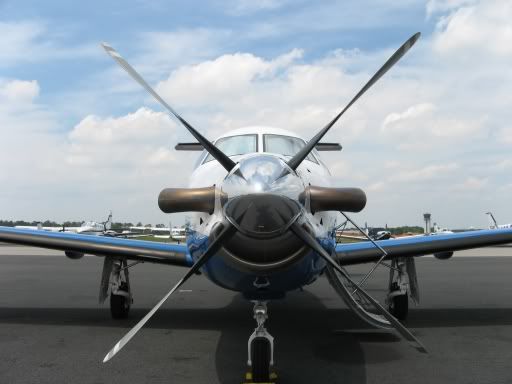
Then there are the aircraft that are altitude limited due to arcane FAA rules. My son's PC-12 is altitude limited to FL300 due to the fact that the FAA mandates that oxygen masks must descend from the overhead in the case of a loss of cabin pressure above FL300. The masks in a
PC-12 come out of the
side of the cabin and therefore don't meet the FAA requirement.
Regards,
James
Re: wow guys
Posted: Wed Jul 19, 2006 7:51 am
by JHEM
bill bolton wrote:shiyang wrote:at flight level 370 [370k ft] on a 757-200
Somehow or other, I don't think that 757-200s are rated for sub-orbital flight!
Obviously, I didn't catch shiyang's error in equating FL370 to 370
K feet rather than 37K feet the first time around.
Good catch Bill!
Regards,
James
Posted: Wed Jul 19, 2006 11:58 am
by mpcook
jdhurst wrote:I see your point, but I remain skeptical. Denver is 5000 feet in the air. Do batteries deplete faster in Denver? I am not arguing, please understand; it is just hard for me to understand and imagine. A USB fan I saw consumes 80mA (0.4 watts at 5V), whereas hard drive consumes about 0.9 watts at low power idle state. I suppose if a fan were always on and the hard drive was always off it could consume more power, but I still am not sure the fan is the explanation.
... JD Hurst
I can speak from experience living at 9200 feet near Boulder CO a few years ago, my T21 did not suffer a decrement in battery life due to the altitude. My son is using it in Denver now, but its been beat to death over the past few years so I can't vouch for the battery life at 5000 feet.

Posted: Wed Jul 19, 2006 12:42 pm
by christopher_wolf
What does battery life still have to do with this?
I am still curious to find out how the cooling system performs at various altitudes; that is, I think, the only thing left, after resolving that power provided by the battery does not vary that much in flight, that just *might* be able to make a tiny enough difference.
Not that I am volunteering myself to go on a long flight just to test this out on my T43. The last flight I had to a conference on the east coast was long, mainly warm, then the cold hit like a brick wall. Once per year is enough.
Posted: Wed Jul 19, 2006 1:44 pm
by asiafish
If someone wants to sponsor a test, I'll happily fly to Europe and test battery life on any ThinkPad they want, all for the price of the ticket and 3 days lodging in Rome, Paris or London.
Posted: Wed Jul 19, 2006 2:43 pm
by Kyocera
asiafish,
If someone wants to sponsor a test, I'll happily fly to Europe and test battery life on any ThinkPad they want, all for the price of the ticket and 3 days lodging in Rome, Paris or London.

Excellent idea!!
Posted: Fri Jul 21, 2006 9:09 pm
by vanaya
I'll buy the first round where ever you lodge...
That should ease your stress from all the math...
Posted: Wed Jul 26, 2006 11:48 pm
by Boricua65
Same thing happened to me as what happened to egibbs. I was watching a movie on a flight to Florida and the laptop kept blowing out hot air. I also wondered if it was because the movie I was watching, which I didn't get to finish (Tomb Raider

).
Posted: Thu Jul 27, 2006 12:54 am
by NS
I have this experience when i was on a flight to USA, California last week. Now i am still in the US..
I was watching and playing some games on my tp and i used the power supply on the plane which is near the front where you board and alight. That power socket there is for the staffs to vacuum the plane. Well, i used that to power up my TP. I was playing my WW2 games and some intensive graphics games and my TP did not produce hot air until i start watching terminator 3 and this is when i place my hand at the ventilation grilles and i could feel strong intense heat producing from my TP and it feels like the heat is burning my flesh on my hand. I quickly pause the movie and open task manager to check what is the cause of this heat problem and i saw something is running my CPU to 100%. I checked for the program which used a lot of the memory but found none so i shut down my comp for a little while and switch it on again 30 minutes later and still the problem persists. Later when i alighted the plane, i asked the people around who is also using their notebooks during the flight and they said that they also experience the same thing.. ??
Why huh??? *scratch*

Posted: Thu Jul 27, 2006 3:38 am
by rkawakami
Possibly you have a built-in wireless card? I understand that there was an article sometime within the last year about a writer who was on a plane and was able to establish an ad-hoc network connection with other people's laptops.
(edit: I believe that this was in violation of FAA rules - computers must disable wireless radios while in flight.)