Indepth analysis of keyboard sturdiness: T4x vs. T6x (Long)
Posted: Sat Jun 27, 2009 12:25 pm
While there is now almost a consensus that the overall build quality of the T6x series is superior to that of the T4x, one of the things that people, on average, rank higher on a T4x is the way the keyboard feels. Although not everyone agrees, and many discussions have spurred on the difference in feel between different keyboard manufacturers, my personal experience, after 4+ years with a T42 and 2 years during which I played with a few different T60/Z61t/T61 units, leads me to conclude that the difference IS there, and it IS in favor of the T4x.
Prelude:
Most of my experience both on T4x/R5x and T6x/Z6x keyboard has been with NMB. If there are tangible differences due to manufacturer, the experience may be different. However the things I will discuss in this post seem, to me at least, as more fundamental, so I am inclined to believe that this difference will not be big.
Symptoms:
So what is the difference in feel between T4x and T6x? Well, I'd say, that it's mostly how firm the keyboard and each individual key is.
With my T42, each key is 100% firm, and gives excellent feedback. The only way to get any part of the keyboard to flex is to apply strong pressure, which never occurs during normal typing. The keyboard is more rigid than most desktop keyboard, including my favorite Lenovo USB Enhanced keyboard. One of my neighbors has an R50e, and the keyboard feels exactly same - firm, excellent feedback, no flex, quiet.
On the T60, while the typing experience is still excellent, it still does not feel quite the same. The keyboard feels softer, flexes much easier if pressure applied at certain points, individual keys feel more mushy. Overall keyboard sturdiness seems uneven across the board, with the right half feeling as sturdy as the T4x keyboard, and the top left quadrant experiencing the worst flex. I experienced this to varying degrees and with slightly varying symptoms on three different T60s (both 14" and 15"), one Z61t, and all of my colleagues' T61s (although 95+% of my typing experience has been with the T60s).
Before continuing, I must reiterate that overall the typing experience is still excellent. If it wasn't for my perfectionism and experience with the T42, I probably wouldn't even notice it. In fact, it took a long time before I started actually differentiating the feelings. The advantage of the T42 is not big, but it IS there, undeniably.
Symptoms indepth:
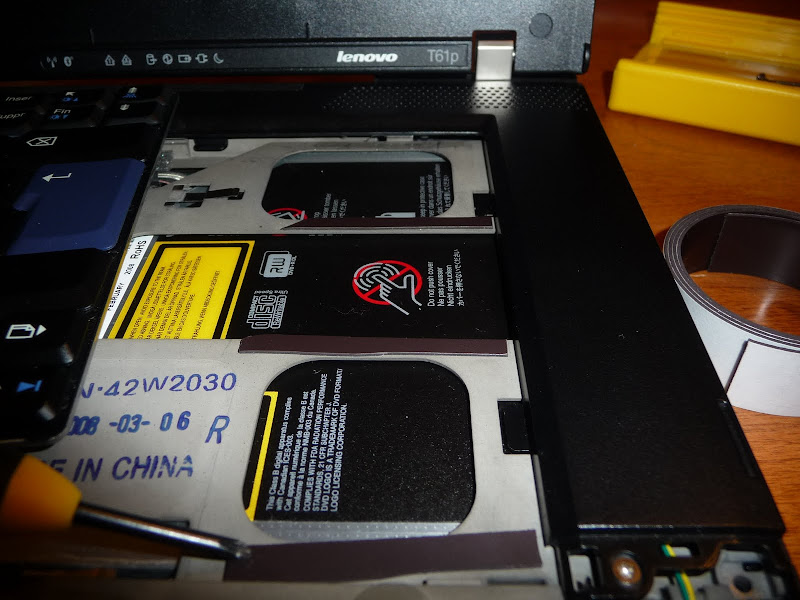
In addition to the feeling that the left side of the keyboard is less rigid, I also noticed that some keys are louder, emitting a hollow or a doubled sound when pressed. A brief investigation showed that the reason is that the keyboard support under these keys is simply insufficient, and so it does not sit flat, and there is a gap of air between the keyboard and the chassis, which causes the entire keyboard to depress and hit the chassis when a key in the area is pressed, producing the hollow sound. This symptom is exhibited by several keys: F3/F4, 3, 4, E, and a few others. If I press and hold down the plastic frame around the Thinkvantage and sound buttons, the keys become much firmer and quieter.
This also explains why the problem is mostly experienced on the left side. On the right side, the rollcage and optical drive provide firm support to the keyboard, which is missing on the left side, where the keyboard lies directly on top of the fan and other components.
One would think that this problem can be solved by adjusting and reseating the keyboard and palmrest. However, experience shows that this is not as simple as it sounds. I tried it multiple times with multiple machines, and while sometimes I could get better results, I could not achieve a 100% firm keyboard. Granted, I may not be as handy as some (although the IBM repairmen that fiddled with the chassis a few times did not overall do a better job than me), but I must say, that I disassembled and reassembled the keyboard on the T42/R50e a couple times, and not once experienced any sturdiness issues. The keyboard always sits firm.
Now, the keyboard backplate itself is no less rigid on the T4x than on the T6x (unlike the new T400/T500 keyboards), so what is the likely cause to this behavior? Continue onto the next section to find out.
Root Cause:
I believe that the answer is simply due to the differences in how the keyboard is held down on T4x/R5x compared to the 60-series models. In the old Thinkpads, the keyboard is screwed in by 3 or 4 screws (depending on 14" or 15"). Tightening the screws makes the keyboard firmly attached to the chassis in several spots, eliminating gaps and flex.
On the 60-series, there is only one screw, right in the middle of the keyboard. This cannot hold the keyboard down well enough. Instead, the construction relies on the palmrest holding the keyboard down. The palmrest is fixed by 4 screws, distributed almost evenly across the width of the laptop. In theory this may sound good, but on practice, while the bottom part of the keyboard is held down quite well, the top part still has too much freedom, which is why the worst issues of flex are experienced in that top left area, which is poorly supported by the chassis and isn't held down strongly enough by the palmrest.
Playing with the palmrest and keyboard screws, tightening and loosing them until a good balance is achieved, can help somewhat. However, it is problematic, because there are too many degrees of freedom in the construction. Moreover, the screws and screwposts do tend to wear out more and more each time you mess with them, and there is a risk of ending with something completely loose one of these days (not to mention that the palmrest itself is fairly fragile around the corners and can break when attached/removed).
So the situation leaves me a bit disappointed with the keyboard sturdiness on the T6x (and compatible) series, and looks like most of the problems are due to design.
Why was it changed from the successful implementation of the T4x series? I don't know. The idea of reducing the number of screws does not hold, since you have to remove all palmrest screws and the palmrest itself to access the keyboard now. Maybe the idea was to reduce the number of screws in the keyboard, to make more paths for the liquid drainage holes, I don't know. Whatever the reason was, it just didn't work. Not 100%.
Side note:
Incidentally, it seems like the 4 palmrest screws on the T60 are not even sufficient so completely securely hold the palmrest down. There is some flex and lack of flatness in the area directly under the left arrow key (where the palmrest has a corner), especially on 15" models. I feel that a fifth screw post there would be a good idea, but Lenovo engineers probably wanted to reduce the number of screws to the minimum possible that will still keep the construction solid enough, so they didn't put it. And it's not like the flex there is anything detrimental to the overall sturdiness of the construction. It is just a (very minor) cosmetic issue.
Prelude:
Most of my experience both on T4x/R5x and T6x/Z6x keyboard has been with NMB. If there are tangible differences due to manufacturer, the experience may be different. However the things I will discuss in this post seem, to me at least, as more fundamental, so I am inclined to believe that this difference will not be big.
Symptoms:
So what is the difference in feel between T4x and T6x? Well, I'd say, that it's mostly how firm the keyboard and each individual key is.
With my T42, each key is 100% firm, and gives excellent feedback. The only way to get any part of the keyboard to flex is to apply strong pressure, which never occurs during normal typing. The keyboard is more rigid than most desktop keyboard, including my favorite Lenovo USB Enhanced keyboard. One of my neighbors has an R50e, and the keyboard feels exactly same - firm, excellent feedback, no flex, quiet.
On the T60, while the typing experience is still excellent, it still does not feel quite the same. The keyboard feels softer, flexes much easier if pressure applied at certain points, individual keys feel more mushy. Overall keyboard sturdiness seems uneven across the board, with the right half feeling as sturdy as the T4x keyboard, and the top left quadrant experiencing the worst flex. I experienced this to varying degrees and with slightly varying symptoms on three different T60s (both 14" and 15"), one Z61t, and all of my colleagues' T61s (although 95+% of my typing experience has been with the T60s).
Before continuing, I must reiterate that overall the typing experience is still excellent. If it wasn't for my perfectionism and experience with the T42, I probably wouldn't even notice it. In fact, it took a long time before I started actually differentiating the feelings. The advantage of the T42 is not big, but it IS there, undeniably.
Symptoms indepth:
In addition to the feeling that the left side of the keyboard is less rigid, I also noticed that some keys are louder, emitting a hollow or a doubled sound when pressed. A brief investigation showed that the reason is that the keyboard support under these keys is simply insufficient, and so it does not sit flat, and there is a gap of air between the keyboard and the chassis, which causes the entire keyboard to depress and hit the chassis when a key in the area is pressed, producing the hollow sound. This symptom is exhibited by several keys: F3/F4, 3, 4, E, and a few others. If I press and hold down the plastic frame around the Thinkvantage and sound buttons, the keys become much firmer and quieter.
This also explains why the problem is mostly experienced on the left side. On the right side, the rollcage and optical drive provide firm support to the keyboard, which is missing on the left side, where the keyboard lies directly on top of the fan and other components.
One would think that this problem can be solved by adjusting and reseating the keyboard and palmrest. However, experience shows that this is not as simple as it sounds. I tried it multiple times with multiple machines, and while sometimes I could get better results, I could not achieve a 100% firm keyboard. Granted, I may not be as handy as some (although the IBM repairmen that fiddled with the chassis a few times did not overall do a better job than me), but I must say, that I disassembled and reassembled the keyboard on the T42/R50e a couple times, and not once experienced any sturdiness issues. The keyboard always sits firm.
Now, the keyboard backplate itself is no less rigid on the T4x than on the T6x (unlike the new T400/T500 keyboards), so what is the likely cause to this behavior? Continue onto the next section to find out.
Root Cause:
I believe that the answer is simply due to the differences in how the keyboard is held down on T4x/R5x compared to the 60-series models. In the old Thinkpads, the keyboard is screwed in by 3 or 4 screws (depending on 14" or 15"). Tightening the screws makes the keyboard firmly attached to the chassis in several spots, eliminating gaps and flex.
On the 60-series, there is only one screw, right in the middle of the keyboard. This cannot hold the keyboard down well enough. Instead, the construction relies on the palmrest holding the keyboard down. The palmrest is fixed by 4 screws, distributed almost evenly across the width of the laptop. In theory this may sound good, but on practice, while the bottom part of the keyboard is held down quite well, the top part still has too much freedom, which is why the worst issues of flex are experienced in that top left area, which is poorly supported by the chassis and isn't held down strongly enough by the palmrest.
Playing with the palmrest and keyboard screws, tightening and loosing them until a good balance is achieved, can help somewhat. However, it is problematic, because there are too many degrees of freedom in the construction. Moreover, the screws and screwposts do tend to wear out more and more each time you mess with them, and there is a risk of ending with something completely loose one of these days (not to mention that the palmrest itself is fairly fragile around the corners and can break when attached/removed).
So the situation leaves me a bit disappointed with the keyboard sturdiness on the T6x (and compatible) series, and looks like most of the problems are due to design.
Why was it changed from the successful implementation of the T4x series? I don't know. The idea of reducing the number of screws does not hold, since you have to remove all palmrest screws and the palmrest itself to access the keyboard now. Maybe the idea was to reduce the number of screws in the keyboard, to make more paths for the liquid drainage holes, I don't know. Whatever the reason was, it just didn't work. Not 100%.
Side note:
Incidentally, it seems like the 4 palmrest screws on the T60 are not even sufficient so completely securely hold the palmrest down. There is some flex and lack of flatness in the area directly under the left arrow key (where the palmrest has a corner), especially on 15" models. I feel that a fifth screw post there would be a good idea, but Lenovo engineers probably wanted to reduce the number of screws to the minimum possible that will still keep the construction solid enough, so they didn't put it. And it's not like the flex there is anything detrimental to the overall sturdiness of the construction. It is just a (very minor) cosmetic issue.
 I'm not sure if it's the power of suggestion, but it certainly seems like that left-hand side is very hollow and doesn't provide the same solid snap as the right.